Architecture · 7 min read · Aug 12, 2026
More agents is not more capability.
Multi-agent architectures are the default diagram in most AI proposals now, usually drawn before anyone has established that one agent was insufficient. Sometimes splitting the work is right. Often it converts a debuggable system into an undebuggable one.
What splitting actually buys
There are three real benefits, and it is worth being able to name which one you are pursuing before drawing the diagram.
- Context isolation. Each agent sees only what its step needs, so noise and errors stop propagating forward.
- Separable evaluation. A narrow component can be tested on its own; a monolith can only be judged end to end.
- Different privileges per step. An agent that reads untrusted content and one that holds credentials should not be the same agent.
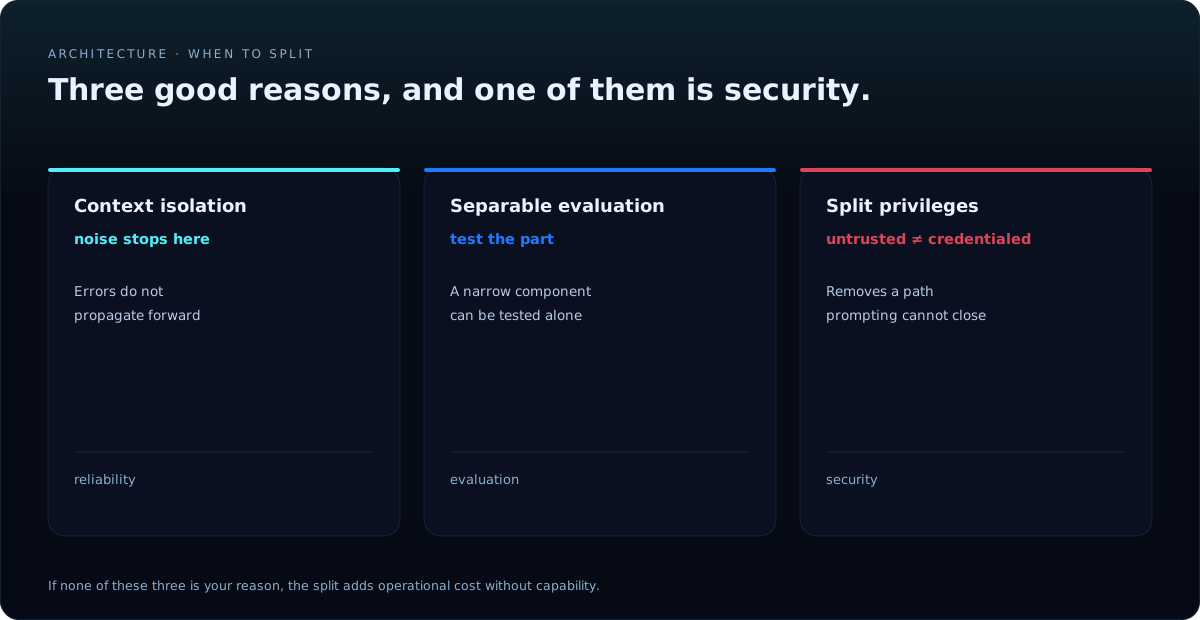
That third one is a security argument rather than a capability argument, and it is the most defensible reason to split. If untrusted input and privileged access currently meet in one context, separating them removes a direct path an attacker can use — and no amount of prompt hardening achieves the same thing.
What splitting costs
Every boundary you add is a place information is lost and a place failure can hide.
| Cost | How it shows up |
|---|---|
| Error compounding | Small per-step failure rates multiply across a chain |
| Lost nuance | Each handoff is a summary; detail does not survive it |
| Attribution difficulty | A bad final answer has five plausible causes |
| Latency and cost | Every step is another call, and they add up |
| Nondeterminism | Same input, different path, different result |
Error compounding is the one that surprises people, because it is arithmetic rather than judgement. Steps that are individually reliable stop being collectively reliable as the chain lengthens — and this is precisely why long autonomous chains demo well on a happy path and disappoint on real inputs.
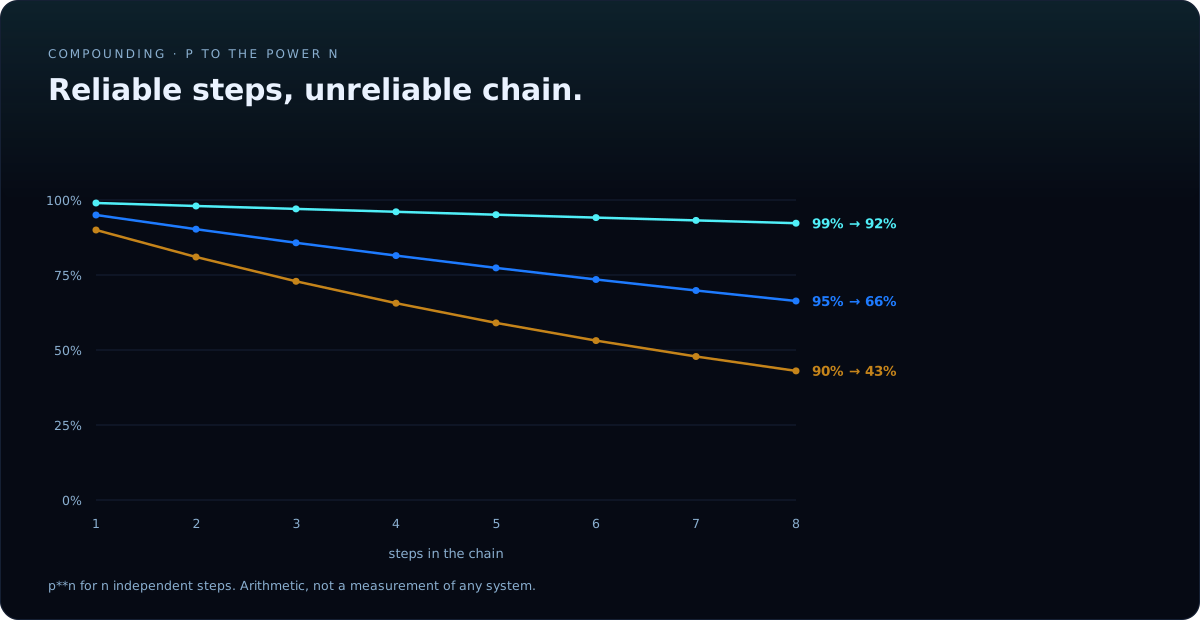
A five-step agent chain where each step is 95% reliable is not a 95% reliable system. Reliability has to be designed at the chain level, not assumed from the parts.
Try the simpler thing first
Before splitting into agents, most problems attributed to a single agent's limits are better addressed one layer down: better retrieval so the right material is present, tighter context so critical instructions are not diluted, and structured tool definitions so the model is choosing between clear options rather than inferring intent.
The useful diagnostic is what the failures look like. If the agent fails because it did not have the right information, splitting will not help — you have a context problem and adding a coordinator adds a place for the information to get lost. If it fails because it is genuinely juggling incompatible jobs in one context, splitting is the right response.
The shapes that work
Where multi-agent designs hold up in production, they tend to look like pipelines rather than conversations. Fixed sequence, defined contract at each boundary, validation between steps, and no agent deciding at runtime which other agent to consult.
The pattern that reliably disappoints is the opposite: autonomous agents negotiating with each other to decide who does what. It is the most compelling architecture on a slide and the hardest to make behave the same way twice, because the coordination itself becomes nondeterministic and there is no single place to look when it goes wrong.
Two structural rules make the difference in practice. Validate between steps rather than trusting handoffs — a schema check at each boundary catches compounding errors while they are still attributable. And keep the orchestration in ordinary code rather than in a model: a deterministic controller calling models for the judgement calls is dramatically easier to test, reason about and debug than a model deciding the control flow.
The question to answer first
Before adding an agent, answer this: what will this component do that the existing one cannot, and how will I know which component was responsible when the output is wrong?
If the second half has no clear answer, the split will make the system harder to operate without making it more capable. That is the common outcome, and it is usually discovered several months after the architecture was fixed.
Dealing with this in your own group?
We answer scoping questions before there's a contract in sight — including the ones about cost and data handling.