Buying · 9 min read · Sep 16, 2026
The indices tied. So the decision moved.
Anthropic shipped Claude Fable 5.1 on 1 September 2026 and OpenAI followed with GPT-6 Astra on the 3rd, and the comparison pieces arrived the same week. Most of them rank the two. That is the least useful thing you can do with them, because on the independent composites they are tied — which means the choice is decided by terms that no benchmark reports.
What the independent numbers actually say
Two different scoreboards disagree, and which one you read decides the answer you get. Artificial Analysis reports both flagship composites as dead heats — 53 on the Intelligence Index (v4.3) and 62 on the Coding Agent Index (v1.4) — with Astra reaching those ties at roughly 40% and 60% of Fable's cost respectively. On OpenAI's own published comparison table, Astra leads nearly every row. eWeek's write-up puts the divergence plainly.
When the vendor's table and the independent index reverse each other, the honest conclusion is not that one is lying. It is that the difference is inside the measurement error of what those tests can resolve — which is the same thing we argue about benchmarks generally in why benchmark scores don't predict production.
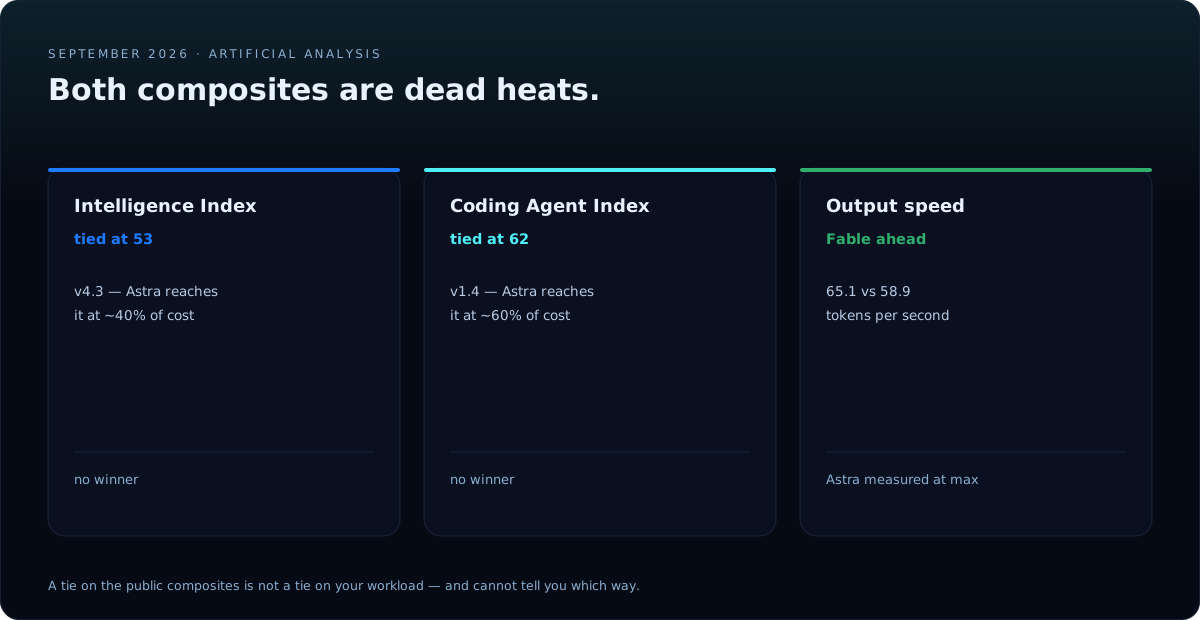
Two models tied on the public composites will not be tied on your workload. But the benchmark cannot tell you which way, so stop asking it to.
The published specifications, side by side
| GPT-6 Astra | Claude Fable 5.1 | |
|---|---|---|
| API id | gpt-6-astra | claude-fable-5-1 |
| Context window | 1,050,000 tokens | 1,000,000 tokens |
| Max output | 128,000 tokens | 128,000 tokens |
| Knowledge cutoff | 30 April 2026 | June 2026 |
| Headline input / output | $10 / $50 per M | $10 / $50 per M |
| Cached input | ~4x Fable's rate | ~1/4 of Astra's rate |
| Output speed | 58.9 tokens/sec (max) | 65.1 tokens/sec |
| Retirement commitment | none published | not before 1 Sep 2027 |
Headline token prices are identical, which is what most comparison tables stop at. The rows underneath it are where the money is.
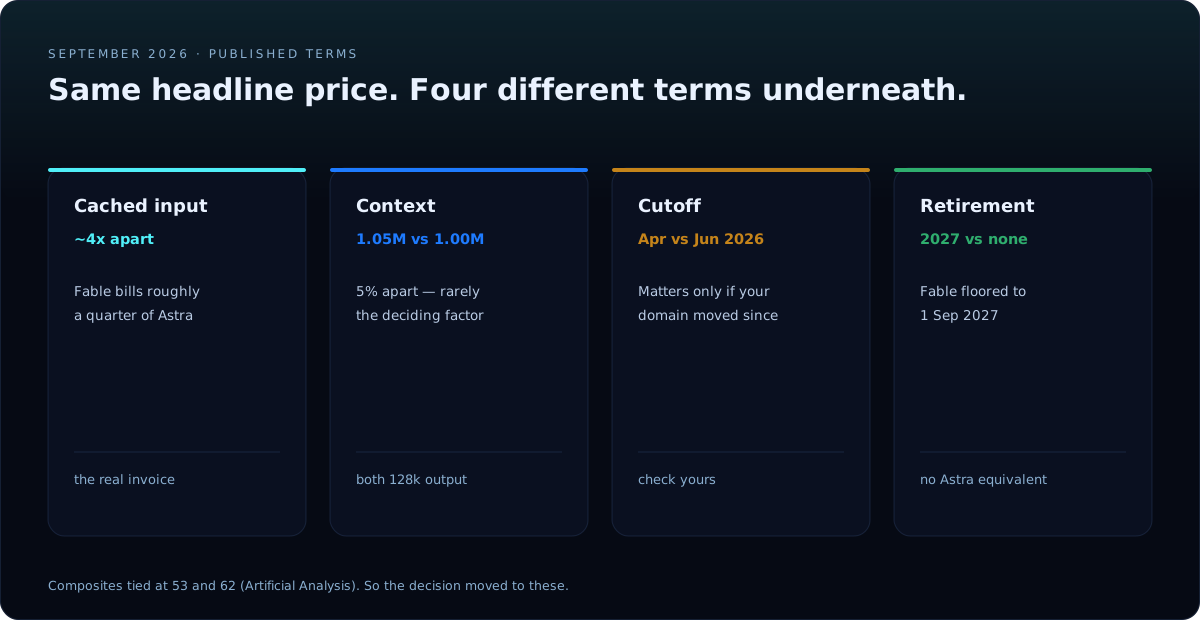
Cache rate is the number, not the headline price
Any system that re-sends the same instructions, schema or retrieved corpus on every call — which is to say every production system — spends most of its input budget on repeated tokens. Fable 5.1 bills cached input at roughly a quarter of Astra's rate. On a workload that is 80% cache hits, that gap moves the monthly invoice far more than a point of index score ever could.
This cuts the other way too. Astra reaching the same composite at ~40% of the cost on Artificial Analysis's measurement is a real result for workloads that are mostly fresh input — one-shot classification over new documents, say, where nothing repeats. The two facts are not in conflict; they describe different traffic shapes. Work out which one describes yours before reading either as a verdict.
The term nobody benchmarks: how long the model lives
Anthropic has committed not to retire Fable 5.1 before 1 September 2027. There is no equivalent published commitment for Astra. For a demo this is irrelevant. For a system that has an evaluation set, a tuned prompt and a year of validated behaviour behind it, a deprecation notice is a re-qualification project — the entire evaluation suite has to be re-run, and behaviour changes on upgrade even when the upgrade is an improvement.
Price that. A twelve-month floor under the model is worth real money to anyone running something they cannot casually re-test, and it appears on no scoreboard.
Where they genuinely differ in character
- Astra is the computer operator. Stronger on mathematics and on agents that drive a machine; faster and cheaper per task on the independent measurement.
- Fable is the reasoning workhorse. Better economics on long context and on cache, with adaptive always-on thinking, and a qualitative edge reported in code review and front-end work.
- Astra carries a monitorability regression. OpenAI flagged it themselves: the model's internal reasoning is harder to audit than its predecessor's, and some cyber capabilities are gated behind restricted access.
- Fable's cutoff is later — June 2026 against Astra's 30 April 2026 — which matters only if your domain moved in between, and is worth nothing if it did not.
That third point deserves more weight than it usually gets. A system whose reasoning you cannot audit is harder to contain when it is wrong, and containment is the property that decides whether a failure is a queue item or an incident — the argument we make in full in what happens when an AI agent gets it wrong.
How to actually decide
Build the abstraction first and choose second. A model-agnostic call layer costs a day and turns this decision into a configuration value, which is the correct shape for a decision that will be revisited within a year. Then run both against your own evaluation set — a hundred cases drawn from your own history, including the exceptions — and read the cost per run alongside the pass rate.
That exercise answers the question in an afternoon and keeps answering it after the next release. Picking from a comparison table answers it once, for a leaderboard that has already moved.
Figures and specifications above are as published in September 2026 and will date. Check the model cards and Artificial Analysis before acting on any of them.
Dealing with this in your own group?
We answer scoping questions before there's a contract in sight — including the ones about cost and data handling.