Buying · 9 min read · Sep 16, 2026
Three products. One question tells them apart.
These three get compared as if they were competing purchases. They are not — they are three different amounts of autonomy, and picking the wrong amount is the most common and most expensive mistake in this category. One question separates them cleanly, and it is not a question about the technology.
The question: who decides the next step?
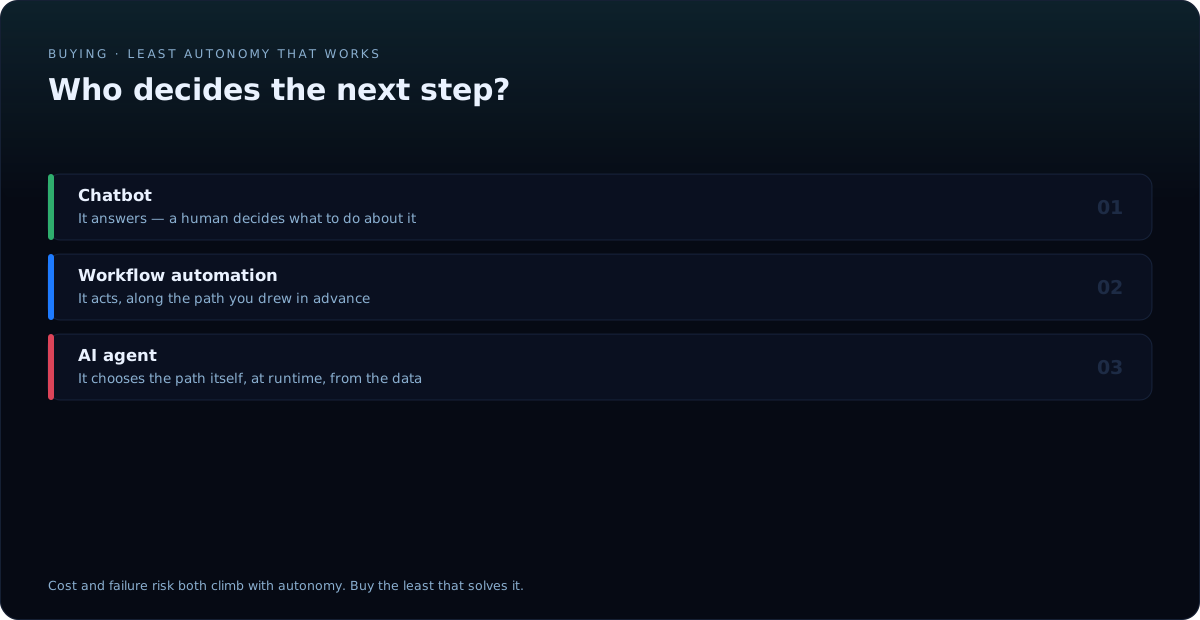
That is the whole taxonomy. A chatbot answers, and a human decides what to do about it. Workflow automation acts, but only along a path you drew in advance. An AI agent chooses the path itself, at runtime, from the data in front of it.
Everything else — which model, which vendor, which integration count — is downstream of that. Get the autonomy level wrong and no amount of model quality rescues it: too little and the exceptions pile up on a human; too much and you have a nondeterministic system where a flowchart would have done, costing more and failing in ways that are harder to reproduce.
Side by side
| Chatbot | Workflow automation | AI agent | |
|---|---|---|---|
| Decides the next step | A human | You, in advance | The model, at runtime |
| Behaviour | Reactive — waits to be asked | Identical every run | Varies with the input |
| Reproducible | Per conversation | Yes | Not reliably |
| Debugging | Read the transcript | Read the flow | Read the trace, then guess |
| Cost driver | Conversations | Executions | Tokens per loop |
| Measured by | Resolution, satisfaction | Throughput, error rate | Task completion, cost |
The reproducibility row is the one that decides operability. A workflow that failed can be replayed and understood; an agent that failed produces a trace that has to be interpreted, and interpreting it is a skill your team may not have on staff.
The screening test
A usefully blunt rule circulates in this literature: if it is the same inputs, same steps, same outputs every time, with no judgement required, it is workflow automation — build it in a deterministic tool and stop. If even roughly a fifth of cases need a different response, you are into conversational or agentic territory.
Buy the least autonomy that solves the problem. Cost and failure risk both climb with autonomy, and neither climbs gently.
That principle is not ours and is not new, but it is worth noticing who states it and who does not. Most of the material defining this category is published by vendors selling one of the three — Lindy, Slack and Glean all publish versions of it. The most trustworthy guidance in the category is consistently the guidance arguing against buying the expensive tier — so weight it accordingly, including here.
They are layers, not rivals
The framing as a three-way choice is itself the error. In every system we have shipped, all three are present and the value sits in the handoffs: the conversational surface captures a request, deterministic orchestration moves it through the systems of record, and the model does judgement work on the narrow part that genuinely needs judgement.
Which means the interesting engineering is not "which one" but "where are the seams". A clean handoff has a schema, a validation step, and a defined behaviour when validation fails. A dirty one passes free text between components and degrades silently — and that failure mode looks identical to a bad model, which is why it gets misdiagnosed for months.
Where each one earns its cost
- Chatbot. When the bottleneck is that people cannot find or phrase things, and a human is going to act on the answer anyway. Cheapest to run, cheapest to be wrong.
- Workflow automation. When the process is stable enough to draw. Cheaper, faster and far easier to debug than the alternatives — and it stays correct while nobody is watching it.
- AI agent. When the sequence of steps genuinely cannot be known in advance. This is a narrower set of cases than the marketing suggests, and it is where the token bill lives.
The sequencing that works: deterministic orchestration first, conversational surface where it helps, agentic decision-making reserved for the specific step that needs it. Reversing that order — starting with an agent because agents are what is being sold — produces a system that is expensive to run and impossible to explain to an auditor.
The question to ask a vendor
Ask which of the three they are selling, and then ask what happens on the case it gets wrong. Those two answers together tell you more than any feature list, and a vendor who will not separate the three is usually charging agent prices for a flowchart. We wrote the longer version of that argument in what an AI solution actually is.
Dealing with this in your own group?
We answer scoping questions before there's a contract in sight — including the ones about cost and data handling.