Commercials · 7 min read · Aug 15, 2026
Four tiers, one rule: route by judgement.
Model releases arrived at a pace in 2026 that makes "which model should we use" the wrong question — it has a different answer every six weeks. The durable question is how you route work between tiers, because that decision survives the next release and it is the one that sets your bill.
Where the tiers sit, as of August 2026
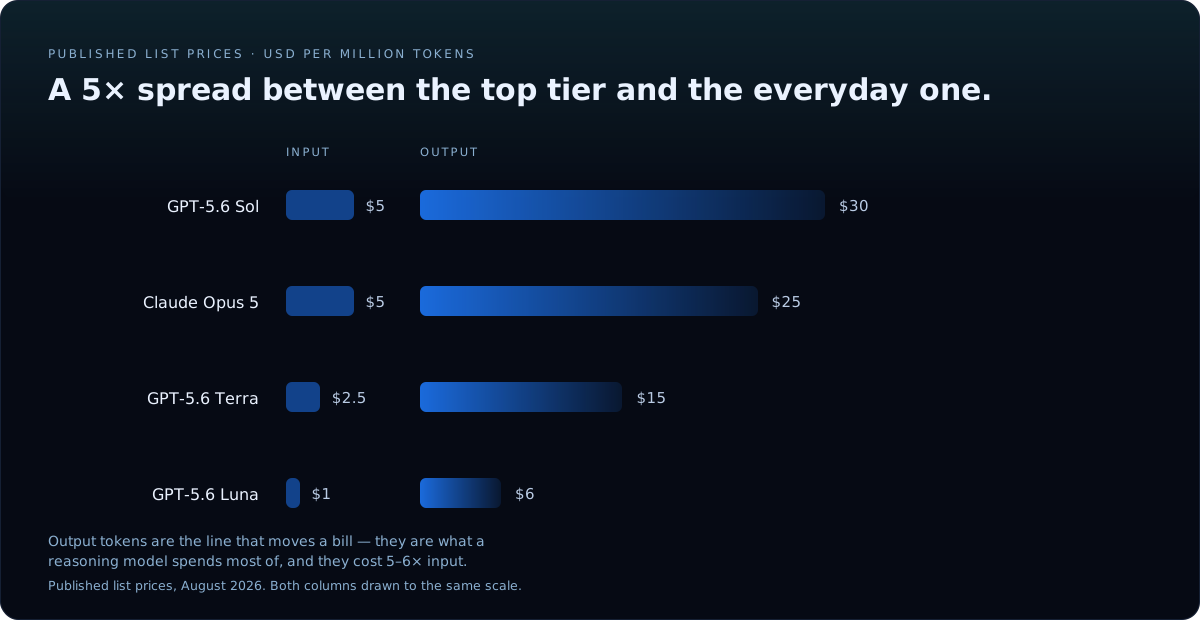
Anthropic released Claude Opus 5 on 24 July 2026 at $5 per million input tokens and $25 per million output — the same price as the Opus 4.8 it replaced, so the improvement arrived at unchanged cost. It also carries an effort setting, letting the same model be run harder for difficult work or lighter to conserve tokens. It was Anthropic's fourth Claude 5 release in under two months.
OpenAI's GPT-5.6 line is explicitly tiered: Sol at $5/$30 for high-end reasoning and complex coding, Terra at $2.5/$15 as the everyday model at roughly half of Sol, and Luna at $1/$6 optimised for speed. Google shipped Gemini 3.7 Flash on 13 August 2026 with an introductory price running to 31 December 2026, alongside Gemini 3.5 Flash-Lite positioned specifically as a low-latency, low-cost subagent for high-volume automation.
The rule: route by whether the work needs judgement
The useful distinction is not "hard" versus "easy". It is whether the task has one defensible answer that a competent person would agree on, or whether it needs weighing. Extraction, classification against a fixed taxonomy, reformatting and summarising to a template are the first kind. Reconciling a variance, drafting something a director will send, or deciding which of four explanations fits the numbers are the second.
| Job | Tier | Why |
|---|---|---|
| Read a document, pull fixed fields | Budget / fast | One correct answer; verifiable against the source |
| Classify against a known taxonomy | Budget / fast | Closed set, and mistakes are measurable |
| Draft a summary to a fixed template | Everyday | Needs fluency, not judgement |
| Explain a variance against context | Reasoning | Weighs several causes; a wrong answer is expensive |
| Anything a director will send unedited | Reasoning | The cost of being wrong is reputational, not computational |
In practice most volume in an operations system is the first kind, and most of the value is in the second. A system that sends everything to the top tier pays reasoning prices for extraction work; one that sends everything to the cheap tier produces confident nonsense on the decisions that matter. Neither is a model problem.
What actually moves the bill
Output tokens. Across every tier above, output costs five to six times input, and reasoning models are exactly the ones that produce more of it. A prompt that asks for working, alternatives and a recommendation costs multiples of one that asks for a decision and a one-line reason — from the same model, on the same task.
This is why the effort setting on Opus 5 and the Flash-Lite class of models matter more than the headline prices. The lever is not which vendor you pick; it is how much thinking you are paying for on work that does not need it. Ontilus sets out the three cost lines in detail in what an AI operating system actually costs to run.
A tiering strategy is worth more than a vendor negotiation. Moving the high-volume half of a workload down one tier typically changes a bill more than any discount you will be offered on the top one.
Why the top tier's price stopped being the interesting number
Opus 5 arriving at Opus 4.8's price is the pattern of the year: capability improves, list price holds or falls, and the tiers below absorb more of the work that used to need the top. For a buyer this has a specific consequence — architect so the tier is a configuration choice per job, not a decision baked into your code.
Groups that hard-coded a single model in 2025 have re-migrated repeatedly since. Groups that put a routing layer in front of it changed a config value. The second group spent less on tokens and considerably less on engineering.
Sources
Dealing with this in your own group?
We answer scoping questions before there's a contract in sight — including the ones about cost and data handling.