Tooling · 8 min read · Aug 15, 2026
Five layers. One of them decides everything.
Every tool list for AI in business is either a directory of 200 products or a pitch. This is the stack we would assemble for a group running several entities on mixed systems, by layer, with the honest note about which layer actually determines whether any of it works.
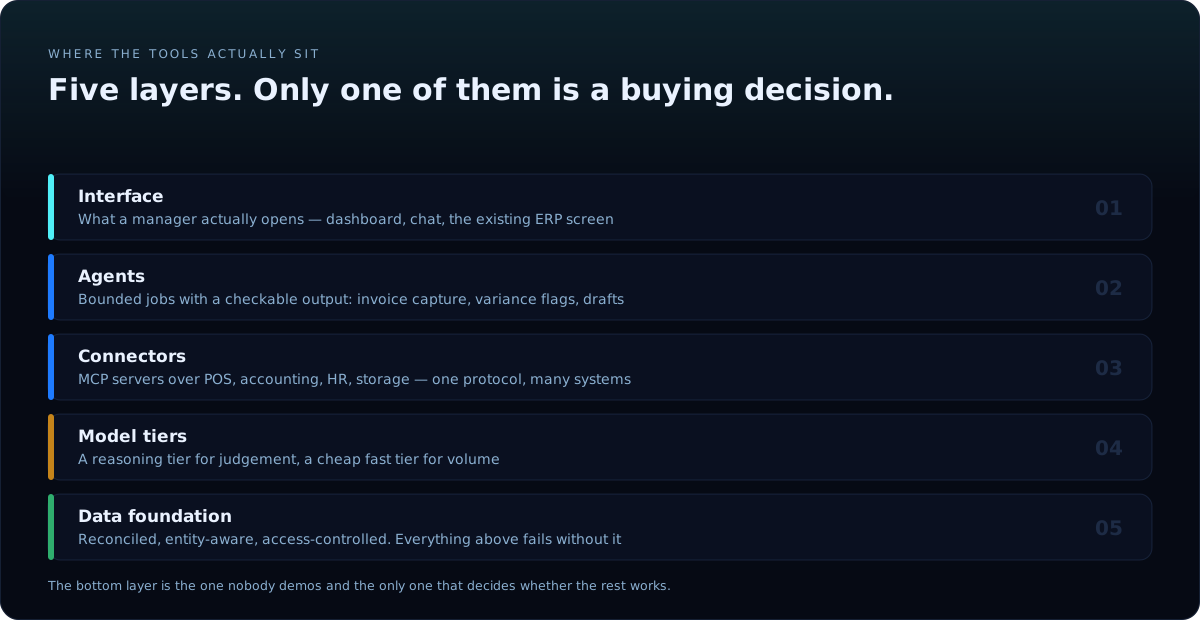
Layer 5 — The data foundation
Listed last in every vendor deck and first here, because nothing above it survives without it. This is reconciled numbers, an entity hierarchy that matches your legal structure, and access control shaped the same way. If your outlets disagree on what "sales" means, no model resolves that — it will produce a confident answer built on the disagreement.
There is no product for this layer. It is the work described in consolidating reporting across POS systems and multi-entity data isolation. Groups that skip it buy the four layers above and conclude that AI does not work for their business. They are half right: it does not work on their data.
Layer 4 — Model tiers
Not a model — tiers, with routing between them. As of August 2026 that means a reasoning tier (Claude Opus 5, GPT-5.6 Sol) for judgement, an everyday tier (GPT-5.6 Terra) for drafting and summarising, and a fast tier (GPT-5.6 Luna, Gemini 3.5 Flash-Lite, Claude Haiku) for high-volume extraction and classification.
Choose at least two vendors and keep the model a configuration value. Four significant releases landed in under two months this year; anything hard-coded will be re-migrated. The routing rule and the pricing are in the 2026 model tiers.
Layer 3 — Connectors
The Model Context Protocol is now the default way to expose your POS, accounting, HR and storage systems to any AI client, and the 28 July 2026 revision made it stateless, cheaper to host and far stricter about authorization. Prefer an MCP server per system over bespoke per-model integrations — the point is to write the connector once and let the model layer change beneath you.
Check that anything you buy authenticates against your existing identity provider. What that change means in practice is covered in MCP went stateless.
Layer 2 — Agents
Platform-maintained agents are worth buying for commodity work: Salesforce Agentforce and the vertical agents embedded in accounting and HR suites now cover invoice handling, compliance checks and data verification competently. Buy those. Build only where the process is specific to your estate.
Whatever you buy or build, scope each agent to a bounded job with a checkable output. The 88% of pilots that never reach production mostly failed this test rather than a technical one.
Layer 1 — Interface
The least interesting layer and the one most often over-built. A manager will not open a new application to check something they already see elsewhere. Deliver into what they already use — the existing dashboard, the ERP screen, a scheduled message — and reserve a dedicated interface for work that genuinely has no home.
If a group has to be trained to open your tool, the tool is competing with their habits. Systems that get used are the ones that appear inside a routine that already exists.
What not to buy yet
- Anything priced per seat across your whole staff before one process is in production. Adoption is the constraint, not licences.
- A second reporting layer. If it disagrees with your close reports, you have added an argument rather than an answer.
- An agent for an irreversible process. Journal posting and payment release come last for good reason.
- Anything that cannot show you its working. On a regulated process, an unexplainable output is unusable however accurate.
The honest summary
Four of these five layers are procurement. One is engineering on your own data, it takes the longest, nobody demos it, and it decides the outcome. That is the whole reason this list is shorter than the ones with 200 tools in it.
Dealing with this in your own group?
We answer scoping questions before there's a contract in sight — including the ones about cost and data handling.