Architecture · 8 min read · Aug 15, 2026
The session went away, and the sticky server with it.
If your group is connecting AI to a POS, an accounting package and an HR system, the protocol underneath that plumbing changed on 28 July 2026 — and it changed in the direction of being cheaper to run and easier to secure.
What MCP is, for someone who does not write the integrations
The Model Context Protocol is a standard way for an AI system to reach the software you already run. Instead of a bespoke integration per model per system, a system exposes an MCP server once and any compliant client can use it. It has become the default: the project reports passing 400 million monthly SDK downloads, roughly a fourfold increase over the year.
The 2026-07-28 revision is the largest since launch. Three parts of it matter to a buyer.
1 — The core is stateless
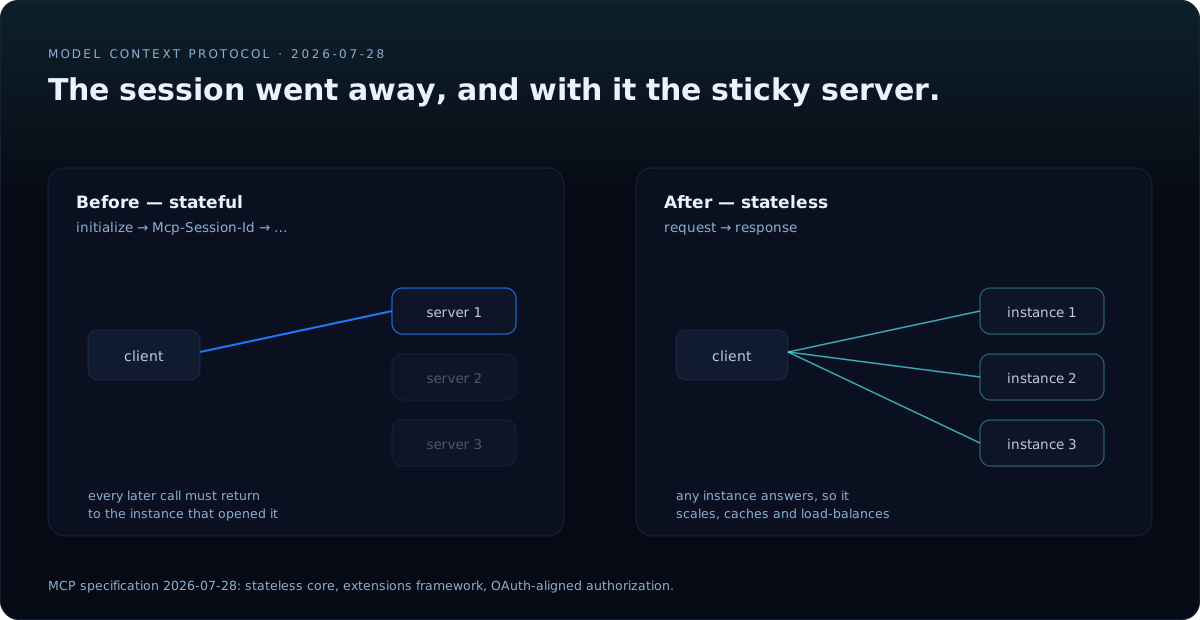
MCP moved from a bidirectional stateful protocol to plain request and response. The initialize handshake and the Mcp-Session-Id header are gone — removed, not deprecated. Sessions previously pinned a client to whichever server instance answered first, so scaling meant session affinity, sticky load balancing and instances that could not share work.
Without them, servers deploy to serverless and edge infrastructure, list results become cacheable, and horizontal scaling is ordinary load balancing. For an operator the consequence is commercial rather than technical: the integration layer becomes something that costs almost nothing when idle, which is most of the time for a system that syncs a POS overnight.
2 — Extensions became a governed system
Capabilities that were informal conventions now ship under a versioned extensions framework with reverse-DNS identifiers, capability negotiation and versioning independent of the core spec. Two matter:
- MCP Apps — server-rendered interactive interfaces running in sandboxed iframes, with tools declaring their UI templates up front so a client can prefetch and security-review them before anything renders.
- Tasks — a stateless lifecycle for long-running work, contributed by AWS:
tools/callreturns a handle and the client drives progress throughtasks/get,tasks/updateandtasks/cancel.
Tasks is the one to care about if any of your jobs take minutes rather than seconds — a month-end consolidation, a bulk reconciliation, a document batch. It gives that work a defined shape instead of a held-open connection.
3 — Authorization got materially stricter
Authorization now aligns closely with OAuth 2.0 and OpenID Connect. Clients must validate the iss parameter on authorization responses per RFC 9207, and client credentials are bound to the issuer that minted them. Dynamic Client Registration is deprecated in favour of Client ID Metadata Documents.
The practical effect is that MCP servers integrate with enterprise identity providers — Microsoft Entra, Okta — as a first-class path rather than a workaround. For a multi-entity group this is the difference between access that follows your existing directory and a second, parallel set of credentials nobody audits. It is the same argument we make about isolation that is enforced rather than remembered.
Roots, Sampling and Logging are deprecated, as is the legacy HTTP+SSE transport, each with at least twelve months of runway. Nothing breaks this quarter — but anything built on them now has a known end date.
What to ask whoever maintains your integrations
- Do we rely on
Mcp-Session-Idor any implicit session state? That is the migration, and it is not optional. - Do we use server-initiated elicitation or sampling? Those move to
InputRequiredResult. - Are we on the experimental Tasks API? It has to move to the new stateless lifecycle.
- Are we still on HTTP+SSE transport? Twelve months of runway is not the same as no deadline.
- Can our MCP servers authenticate against our existing identity provider — and if not, what are they using instead?
The Tier 1 SDKs — TypeScript, Python, Go and C# — already speak the new specification, so this is a scheduling question rather than a blocked one. The groups that will feel it are those whose integrations were written once by a contractor and have not been opened since.
Sources
- Model Context Protocol — 2026-07-28 specification: stateless core, extensions framework, authorization hardening, Tier 1 SDK support.
- MCP project — 400M monthly SDK downloads, approximately 4× year-on-year.
- RFC 9207 — OAuth 2.0 Authorization Server Issuer Identification.
Dealing with this in your own group?
We answer scoping questions before there's a contract in sight — including the ones about cost and data handling.