Operations · 7 min read · Aug 15, 2026
Finance pays back last. That is not a failure.
The reported results from back-office agents are strong enough to look implausible, and the reported payback periods are long enough to look like a contradiction. They are not. The gap between them tells you which process to automate first.
What is actually being reported
Organisations deploying back-office agents report 70–90% reductions in invoice processing time, and automated invoicing, forecasting and expense auditing accelerating close processes by 30–50%. In HR, time-to-hire is reported to fall by around half. In financial services, back-office processing — invoice management, disputes, compliance monitoring — is among the largest deployment categories.
Vendor numbers point the same way. Salesforce reported Agentforce reaching $800M ARR in Q4 FY2026, up 169% year on year across 29,000 customer deployments, with customers claiming over $100M in annualised cost savings; in April 2026 it extended into back-office work explicitly with Agentforce Operations.
And yet finance pays back last
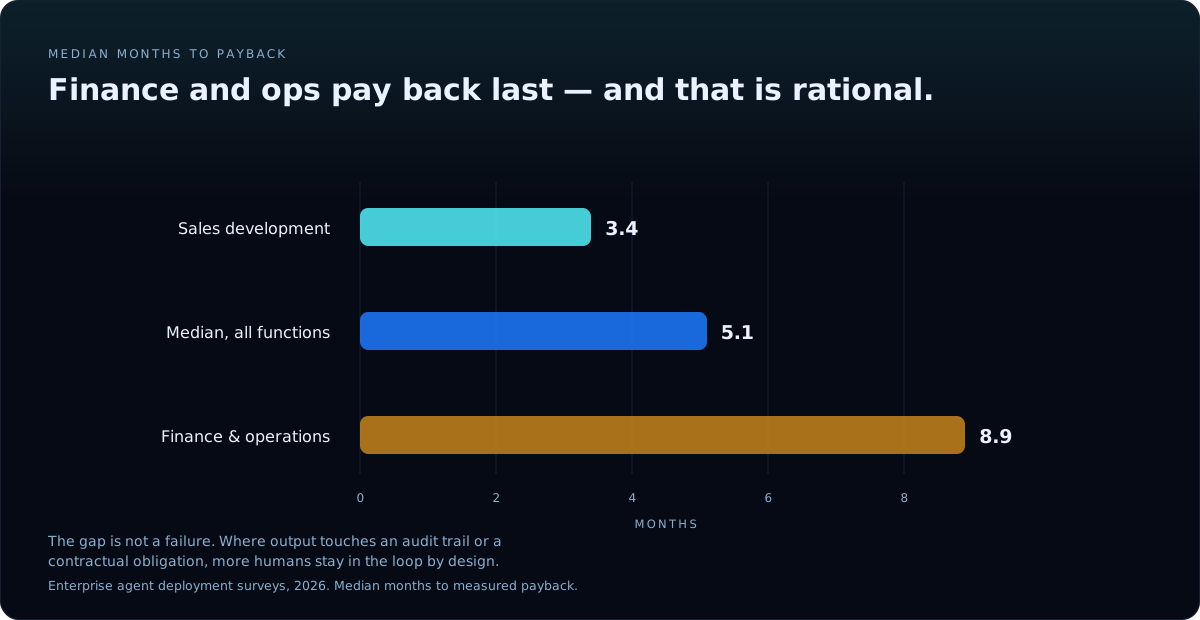
Median time-to-value across functions is 5.1 months. Sales development agents pay back in 3.4. Finance and operations agents take 8.9 — nearly triple the SDR figure, against a process with larger reported efficiency gains. The apparent contradiction resolves once you look at what the two are allowed to do.
An SDR agent that writes a poor email costs one wasted send. An invoice-coding agent that miscodes costs a restatement, an audit finding, or a payment that should not have left. Where output touches an audit trail, a regulated process or a contractual obligation, organisations keep more humans in the loop — deliberately. The longer payback is the cost of that choice, and it is usually the right one.
The finance payback gap is not evidence that finance agents work less well. It is evidence that finance is where being wrong is most expensive, and organisations are pricing that correctly.
The same logic explains the sector spread
Banking and insurance run near 47% adoption of at least one production agent; healthcare sits near 18% and government near 14%. Banking has both the volume and mature control frameworks to absorb an agent inside existing checks. Healthcare and government have the volume but far less tolerance for an unexplainable output. The constraint is not appetite or capability — it is what the surrounding process can verify.
Sequence by checkability, not by size of the prize
The instinct is to start where the manual effort is greatest. The better rule is to start where the output is easiest to check, because that is what determines whether the thing ever gets trusted enough to run. A useful ordering for a multi-entity group:
| Process | Why it comes early or late | Check available |
|---|---|---|
| Supplier invoice capture | Early — ground truth exists on the document | The invoice itself |
| Item and supplier normalisation | Early — errors are visible and reversible | Human review queue |
| Variance flagging on close | Middle — flags a human, does not decide | The close report |
| Expense policy checks | Middle — clear rules, contested edges | The policy |
| Journal posting, payment release | Late — irreversible and audited | Approval chain only |
Note what the last row has in common with the long payback: the check is a person, not a document. That is precisely why it takes longer to earn back, and why attempting it first is how a programme loses its mandate.
Build or buy
The pattern across 2026 deployments is consistent: commodity back-office tasks are increasingly bought as vertical or platform-maintained agents, while genuinely differentiating capability is built. The test is whether the process is one your competitors run identically. Invoice OCR is not a competitive advantage. Knowing that two of your outlets pay different prices to the same supplier — because you did the item normalisation nobody else bothered with — is.
That work is specific to your estate, which is why it does not come in a box. The rest of the method is in consolidating reporting across different POS systems, and there are more working notes in Ontilus's insights.
Sources
- BCG and Forrester surveys, 2026 — median 5.1 months to value; SDR 3.4; finance and operations 8.9.
- 2026 enterprise deployment reporting — 70–90% reduction in invoice processing time; 30–50% faster close.
- S&P Global Market Intelligence and McKinsey, 2026 — sector adoption: banking and insurance 47%, healthcare 18%, government 14%.
- Salesforce — Agentforce $800M ARR Q4 FY2026, 29,000 deployments; Agentforce Operations launched April 2026.
Dealing with this in your own group?
We answer scoping questions before there's a contract in sight — including the ones about cost and data handling.