Architecture · 8 min read · Aug 12, 2026
Not every task needs the big model.
Self-hosting a small model is either an obvious win or an expensive detour, and which one it is depends on facts most teams do not check before starting. Here is the honest accounting on both sides.
The three real reasons to self-host
There are good reasons and there are reasons that sound good. The good ones are specific:
- The data cannot leave. A regulatory or contractual boundary that no provider agreement satisfies. This is the strongest case and it is not really a cost decision at all.
- Volume is enormous and the task is narrow. Millions of near-identical classifications where per-token pricing compounds into a serious number.
- Latency must be local. A network round trip is genuinely too slow, or the system must keep working without connectivity.
The reason that sounds good and usually is not: cost. Self-hosting frequently ends up more expensive than API pricing at anything below high, sustained volume, for reasons covered below.
Capability is not the constraint people expect
Small open models have become genuinely capable at bounded tasks — classification, extraction, routing, summarising a short document, tagging against a fixed taxonomy. For that class of work, the gap to a frontier model is often narrow enough that it does not affect the outcome.
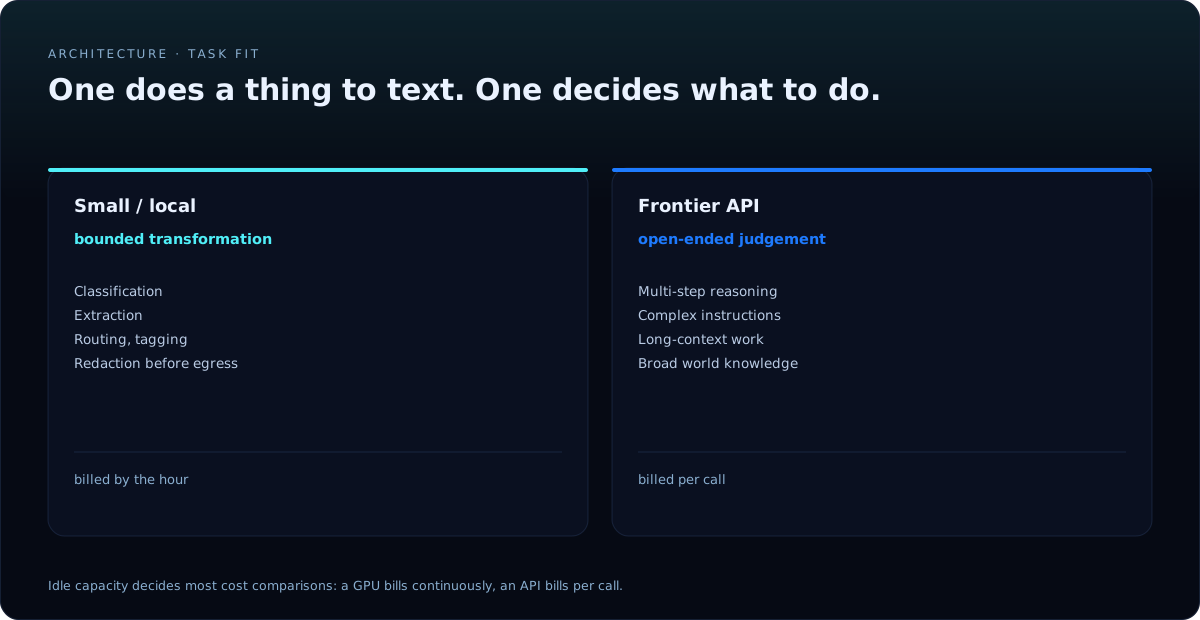
Where the gap remains wide is multi-step reasoning, instruction-following under complex constraints, long-context work, and anything needing broad world knowledge. A useful way to think about it: small models are good at doing one thing to a piece of text. Frontier models are good at deciding what to do.
Most production AI work is bounded transformation, not open-ended reasoning. Which is why routing by task rather than defaulting to one model is usually the cheapest correct answer.
The costs of self-hosting that get missed
The comparison is usually GPU rental against API spend. That is one line of several.
| Cost | Why it gets missed |
|---|---|
| Idle capacity | You pay for the GPU continuously; APIs bill per call |
| Engineering time | Serving, batching, quantisation and scaling are real work |
| Model upgrades | Nobody upgrades your model for you |
| On-call | Your inference is now a service you operate at 3am |
| Evaluation | You own proving the model still works after every change |
Idle capacity is the one that decides most cases. API pricing is consumption-based, so an application with peaky or modest traffic pays nothing between requests. A rented GPU is billed whether or not anything is being asked of it. Below high sustained utilisation, that difference alone usually settles the comparison — and it argues for self-hosting on continuous batch workloads rather than on interactive ones.
The hybrid is usually the answer
This mirrors the model-tier routing argument: match the task to the cheapest thing that does it correctly. A small local model handles the high-volume bounded work — classification, extraction, redaction before data leaves your boundary. A frontier API handles the reasoning, the exceptions and anything open-ended.
One pattern is worth calling out because it solves a governance problem rather than a cost one: running a small local model as a pre-processing step that strips or tokenises identifiers before anything reaches an external provider. You get frontier capability on the hard part while the sensitive fields never cross your boundary. That is often what makes an otherwise-blocked deployment approvable.
How to decide without a pilot
Three checks, in order:
- Is there a hard boundary? If data genuinely cannot leave, self-host and stop comparing costs — that decision is made.
- Is the task bounded and high-volume? Bounded plus sustained volume favours local. Varied or spiky favours the API.
- Do you have someone to operate it? If nobody owns inference as a service, self-hosting adds an operational obligation you have not staffed.
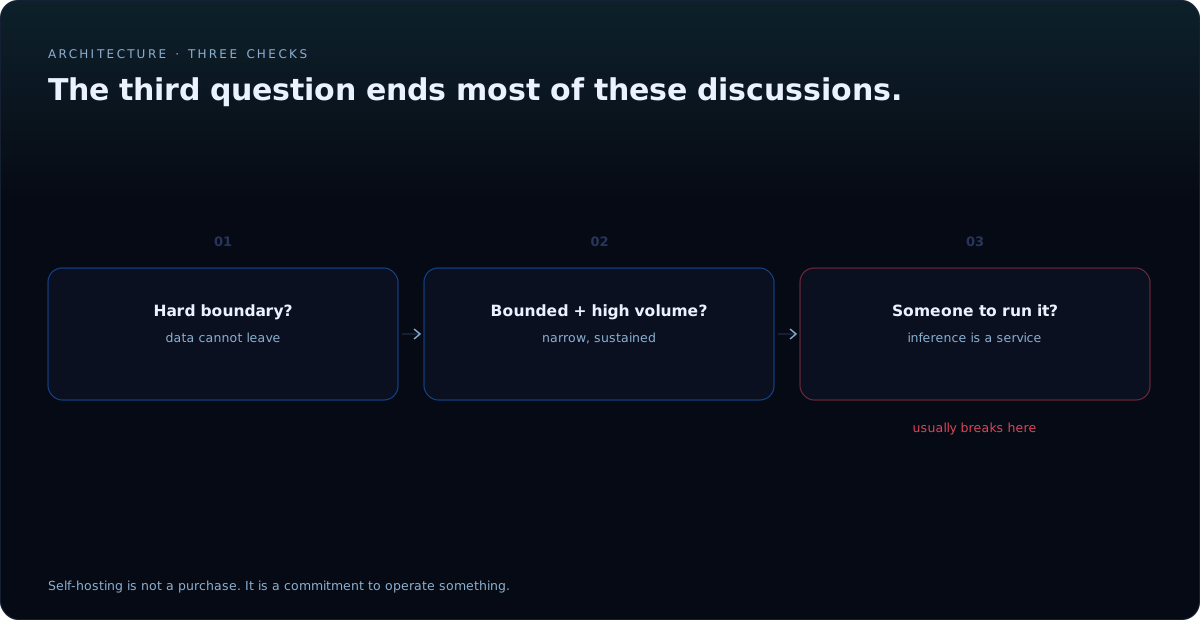
That third question ends more of these discussions honestly than the other two. Self-hosting is not a purchase, it is a commitment to run something — and the same test applies as with any build: are you willing to own it in three years?
Dealing with this in your own group?
We answer scoping questions before there's a contract in sight — including the ones about cost and data handling.